Research Article | | Peer-Reviewed

Middle Permian (Murgabian) Foraminifers Faunas of the Thitsipin Formation, Western Part of the Southern Shan State, Myanmar

Received: 1 October 2025     Accepted: 13 October 2025     Published: 9 February 2026
Views:       Downloads:
Abstract

The Thitsipin Formation exposed at the Pegin Pagoda Hill, Ywa-ngan Township, southern Shan State, Myanmar, represents an important Middle Permian (Murgabian) carbonate sequence within the Shan Plateau. This study presents detailed lithologic, stratigraphic, and paleontological analyses of the limestone unit, focusing on the taxonomy and biostratigraphic implications of its foraminiferal assemblages. Fieldwork involved measurement of stratigraphic sections, fossil sampling, and petrographic examination of 30 thin sections. The lithology is characterized by alternating dark grey, fossiliferous lime-mudstone and crinoidal grainstone interbedded with purplish calcareous shale, forming a 78-meter-thick sequence. Four foraminiferal genera Lunucammina sp., Nodosaria sp., Pachyphloia sp., and Multidiscus padangensis were identified. Among these, Pachyphloia sp. and Multidiscus padangensis are indicative of the Middle Permian (Murgabian) age. The basal portion of the Thitsipin Formation unconformably overlies the Silurian Linwe Formation and yields abundant bryozoans, crinoids, and gastropods, suggesting a shallow marine depositional environment with moderate energy conditions. The discovery of Multidiscus padangensis allows biostratigraphic correlation with coeval units such as the Htam Sang Limestone in Hopong Township. The results confirm the Middle Permian age of the Thitsipin Limestone and refine the regional stratigraphic framework of the southern Shan State. Furthermore, the study provides essential paleontological evidence for understanding the evolution of Permian carbonate platforms in Myanmar and offers a valuable reference for future regional correlations and educational purposes in stratigraphy and paleontology.

Published in Earth Sciences (Volume 15, Issue 1)
DOI 10.11648/j.earth.20261501.14
Page(s) 44-51
Creative Commons

This is an Open Access article, distributed under the terms of the Creative Commons Attribution 4.0 International License (http://creativecommons.org/licenses/by/4.0/), which permits unrestricted use, distribution and reproduction in any medium or format, provided the original work is properly cited.

Copyright

Copyright © The Author(s), 2026. Published by Science Publishing Group

Keywords

Thitsipin Formation, Foraminifera, Middle Permian, Murgabian, Shan State, Myanmar, Stratigraphy, Paleontology.

1. Introduction
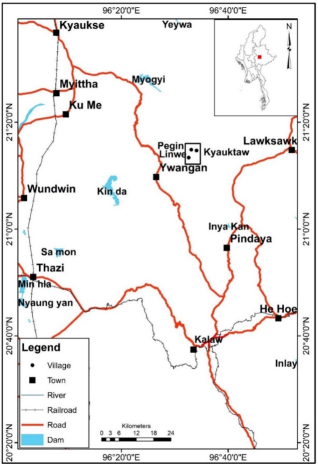
The research area is situated in the northwestern part of the Pindaya Range, Ywa- ngan Township, southern Shan State. Detailed sedimentary and palaeontology investigation were carried out from the limestone of Thitsipin Formation at the Pegin Pagoda Hill as shown in Figure 1. which is located four and a half miles NE of Ye-U and on one-inch topographic map sheet no. 93 C/12. The unit was firstly defined as a basal bed of the Permian Thitsipin Limestone Formation by Garson et.al 1976 and Thura Oo et.al 2002. Important investigators among others who contributed lithostratigraphic and biostraphic aspects of the Pegin area were .
The Pegin area is the interesting place for the stratigraphy, sedimentology and paleontology point of view. The fossils gastropods, bryozoans, algae, foraminifera, and crinoids are fairly abundant. At the present research area, Thitsipin Formation unconformably overlies the Linwe Formation at Pegin Monastery . Limestones of the Thitsipin Formation consist of well-bedded, dark grey, crinoidal and fossiliferous limestone. About four meters from the base, the wavey bedded limestones occur as intercalated nature with purplish calcareous shale. Their trending indicates NNW-SSE in direction and eastward dipping. The purposes of present investigation are firstly to carry out the taxonomic assessment of foraminifers; secondly to synthesize the stratigraphic status of the Thitsipin Formation exposed at the Pegin Pagoda Hill on account of the foraminifers fossils; the last purpose is to make the supplement of studious fields for undergraduate students.
Figure 1. Locality map of the Pegin Pagoda Hill, Pegin Village, Ywa-ngan Township, Southern Shan State.
2. Regional Geologic Setting
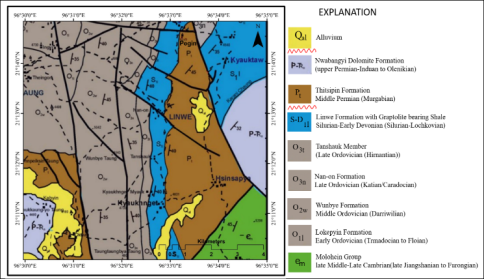
The study region lies in the western part of the Eastern Highlands that is a distinct geotectonic domain . To the west, it is separated from the Central Basin by the Shan Scarp. To the east, the Shan Massif is bordered by the Mekong River. The northern boundary of the Shan Massif is bounded with NNE striking belt of ultrabasic and basic intrusive extending from north of Mogok. Towards south, the Shan Massif decreases in width and extends for a considerable part into northwest Thailand. Large areas of the Shan Plateau are covered by thick carbonate sequences of Ordovician, Silurian, Devonian, and Permian-early Mesozoic age. The Pegin area (Pegin Pagoda Hill) and its environ as shown in Figure 2, lying in the northwestern part of the Pindaya range, southern Shan State. The area is covered by the thick Paleozoic sequence composed of the Pindaya Group and Mibayataung Group , and part of the "Plateau Limestone Group". The Pindaya Group consists of siliceous siltstones with minor number of limestones of Early Ordovician (Lokepyin Formation). It is overlain by the burrowed limestones with silt patches and laminations of Middle Ordovician (Darriwilian) (Wunbye Formation) which is succeeded conformably by fossiliferous, siliceous, and micaceous siltstones, claystones with minor amount of limestone lenses of Late Ordovician (Katian/Caradocian) (Nan-on Formation) and purplish siltstones, mudstone and shale unit of Latest Ordovician (Hirnantian) (Tanshauk Member). The Ordovician sequences are overlain conformably by the interbedded to mixed clastic-carbonate (mostly of nodular limestone with intercalations of some graptolite-bearing shales) sequence of Silurian-Early Devonian (Silurian-Lochkovian) (Linwe Formation, included in the Mibayataung Group). So far, no undoubted Devonian units attaining dacryoconarid tantaculites, such as Nowakia and Styliolina which are common in the Zebingyi Formation of Early Devonian, Pragian or brachiopod, Atrypa racticularis, rugose corals, Calceola sandalina and Phillipsastrea hlawaii, common in the Padaukpin Limestone of Middle Devonian, Eifelian have been recognized in this area. The most widely distributed carbonate rock unit in this region is the Plateau Limestone Group of Permian-Triassic age. The nature of contact between the Silurian and overlying the Thitsipin Formation of Pegin Pagoda Hill seems to be a structural, rather than stratigraphic or unconformable as described in Permian of Myanmar . There may also be no break in sedimentation or sign of unconformity between the mixed clastic-carbonate unit of the Thitsipin Formation and mostly calcitic, coralline, fusuline limestone with partial dolomites of Early to Middle Permian Thitsipin Limestone Formation , which is gradationally passed upward by mostly unfossiliferous dolomitic limestone and dolomites of the Late Permian to Early Triassic Nwabangyi Dolomite Formation.
Figure 2. Geological map of Pegin Pagoda Hill and its environ, Ywa-ngan Township, Southern Shan State .
3. Materials and Methods
Materials of the present research are carried out from the well exposed limestone of the Thitsipin Formation at the Pegin Pagoda Hill which is located at about one and a half miles NNE of Linwe village in Ywa-ngan Township. The present study was carried out with the following procedures in method of study. Firstly, review of previous works on the Permo-Triassic Plateau Limestone was done to synthesize general geology, stratigraphy and paleontologic accounts of the Plateau Limestone. Secondly, during April holiday of the year 2022, field investigation was arranged to the study area and it took about one week. In the field, detailed stratigraphic section measurement was carried out along chosen section line by using tape and compass method to observe detailed lithologic, to record the distribution of fossils and to collect samples. The field equipment used were Brunton Compass, geological hammer, 15x hand lens, and measuring meter-tape. Lithologic boundaries, fossil localities and various types of structural data were plotted as traverse line on the scale of 1 cm to 5 m, in order to determine the succession and structural setting of the rocks of traverse line. During the field, over 23 samples were collected to study taxonomic aspects of foraminifers and associated faunas in the laboratory. In the lab, rock samples collected were washed by pure water. The washed samples were sawed to get at least three pieces of chips for each sample. The chips were systematically labeled and stored with respective samples. The chips were then etched with dilute hydrochloric acid solution (about 7-9%HCL). This etching removes the sawed-powders and scratches, and improves the outlines of fossils appeared on the chips. The lithologic descriptions taken during the field investigation were made on the basis of these etched rock chips. The etched chips were examined with 15x hand lens to mark target area that contain proper sections of foraminifers. The chips were then cut again to trim out target area for making thin-sections. About 30 thin-sections were made to study taxonomy of foraminifers. The thin-section were examined under binocular petrographic microscope (Olympus-CH). Characteristic and representative fossils occurring in thin-sections were taken photomicrographs. And then Taxonomic data of foraminifers and associated fossils for each sample were plotted on stratigraphic columnar section with respect to the collected sample horizons. The foraminers terminology and supergeneric classification follows that of .
Repository: All the collected rock-samples and thin sections are housed in the Banmaw University Geology Museum Fossils and are prefixed by BGMF.
4. Results
4.1. Lithologic Characteristics
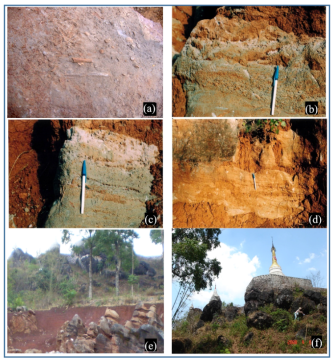
The base of the unit is dominated by medium-bedded lime-mudstone intercalated with purple colored thin shale layers (3 to 23 cm) in thickness Figure 3a. The shale unit is remarkably rich in bryozoa together with small number of tiny brachiopods. The crinoidal lime-grainstone layer is distinctly occurred at 1 m from the base of the section Figure 3b. In this part, most fossils found are fragmentary, complete fossils are rare or absent. The unit becomes arenaceous at the height between 1.5 to 3 m. There are some thin-bedded dark gray lime-mudstones, there lithology is not much changed except fossils become more complete than in the lower, containing large cystoid plates, crinoid stems and unidentifiable shells of brachiopods, gastropods and fragments of bryozoa are scattered on the bedding surface. The unit is more ferruginous giving reddish brown in colored of the outcrop. Foraminifers microfossils especially Middle Permian foraminifers were collected form these portions.
In the middle part (6 m), bedding thicker, medium-bedded lime-mudstone with prominent cross-stratification, more fossils fragments appear in the fossiliferous horizon (about 1 m in thickness) composed of complete and fragments of brachiopods, fenestrate bryozoa, low-spired gastropod and crinoid stem, a small number of chert nodules and stromatoporoids. Purplish siltstone interbedded natures are occasionally present Figure 3c & 3d. The fossils mainly of brachiopods and gastropods are larger in the upper part of the middle portion. Purplish or dark gray or dark gray lime mudstones and siltstone containing a number of gastropod shells still remain.
In the upper part, 9 m above base of the section, the fossil fragments of the above assemblage bearing grainstone occur sporadically. Purer carbonate ratio and less of shale or silt at this horizon. Medium to thickly bedded outcrops are charactically distinguishable from the upper part of this unit to the poorly bedded to massive outcrops of the Permian Thitsipin Formation Figure 3e & 3f. From the biostratigraphic point of view, no fusuline biozone has been so far determined due to the lack of any fusuline taxon at the lower and Middle parts of the measured section.
Figure 3. Photograph showing lithological characters of the Middle Permian Thitsipin Formation, Pegin pagoda hill, Pegin village, Ywa-ngan township, Shan State (south). (a-f) (a) purple coloured thin shale layers in basal part of the Pegin Formation; (b) crinoidal lime-grainstone layer in the basal part of the Thitsipin Formation; (c) fossils fragment bearing layer of the Middle part of the Thitsipin Formation; (d) Lime-mudstone with prominent cross-stratification; (e-f) thick bedded to massive outcrop overlying the mixed clastic and carbonate units of the Thitsipin Formation.
4.2. Faunal Characteristics
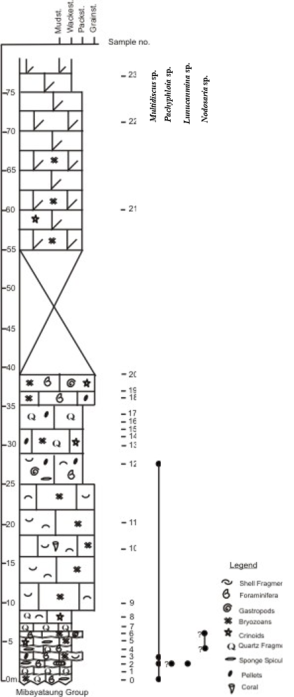
In this section, authors are advised to provide a thorough analysis of the results and make comparisons with The Pegin section is situated at the Pegin Pagoda, Pegin village. Section measurement was carried out between the grid points M093749 and M095750. The total stratigraphic thickness is about 78 m Figure 4. At the base of the section, a nearly ten-meter-thick sequence of well-bedded, dark grey, crinoidal limestone and micritic limestone is well exposed. It is interesting to note that a four-meter-thick interval of wavy bedded, dark gray limestone with purple calcareous shale intercalations, is well exposed at the base of Pegin Pagoda. In this interval, Multidiscus padangensis of the Middle Permian foraminifers are discovered in a dark gray, micritic limestone. Fossils are locally fairly common. No fususline fossil has been noticed at the Pegin Section that is composed mainly of microbioclastic packstone, microbioclastic grainstone, wackestone and minor peloidal packstone and lime mudstone. Partially silicified specimens of M. padangensis commonly occurs in argillaceous microbioclastic wackestone in association with smaller foraminifers (such as Pachyphloia sp. and Tetrataxis sp.), sponge spicules, bryozoans and gastropod coils at the lower part of the section. Large crinoid stems and bryozoans are abundant, especially in the basal portion of the measured section.
Simplified columnar section at Pegin Monastery showing sample collecting horizon with collected fossils is shown in Figure 4. It is here noteworthy that an early Middle Permian smaller foraminifer, Multidiscus padengensis, is characteristically present in the argillaceous limestone facies of the lowest part of the section that unconformably overlies the Linwe Formation of Silurian age. It can be correlated with the Htam Sang Limestone of Hopong Township, southern Shan State .
Figure 4. Columnar section at Pegin Monastery between the grid points M093749 and M095750 (one-inch topographic map no. 93/C12); showing sample collecting horizons with collected fossils.
Systematic Paleontology
Superfamily ENDOTHYRACEA Bardy, 1884
Family NODOSINELLIDAE Rhumbler, 1895
Subfamily NODOSINELLINAE Rhumbler, 1895
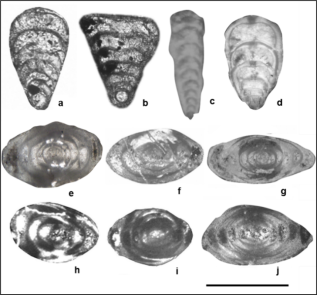
Genus Lunucammina Spandel, 1898 Figure 5a-5b
Type species., Lunucammina devonica Lepina, 1950 (P-213, PL-223, Fig-6) from Russian platform, USSR.
Diagnosis., Test elongate, narrow to broadly flaring and subtriangular in outline, compressed, ovate to reniform in section, commonly with a median longitudinal depression that in slightly tangential longitudinal sections may give the appearance of two opposed and not alternating rows of chambers, globular proloculus followed by gradually widening, low, uniserial and rectilinear chambers, slightly to distinctly arched at the midline of flat sides, sutures medially arched, depressed, wall calcareous with microgranular inner layer and radially striate or fibrous outer layer, surface smooth to longitudinally striate, aperture terminal, rounded to ovate.
Lunucammina sp.
Material., Only two longitudinal section (BGMF- 5003 and 5004)
Description., The test is elongate and subangular in outline. This species occurs and appears an ovate to reniform. It is commonly occurred with a medium longitudinal depression. Consisting of globular proloculus. Chamber are rectilinear and not alternating rows. The present species has six chambers and it is the same as type species.
Comparison and Remarks., They are distributed extensively in Europe, Asia, Australia, and North America. There is no literatures available on the genus Lunucammica of the neighboring regions. Thus, this comparison of the species is only made between the present form and the Germany species .
Geological range., Upper Devonian - Upper Permian
Occurrence., This species is found in the basal part of the Thitsipin Formation, Pegin Pagod Hill, Ywa ngan Township.
Super family NODOSARIOIDEA Ehrenberg, 1838
Family NODOSARIIDAE Ehrenberg, 1838
Genus Nodosaria Lamarck, 1816 Figure 5c
Type species., Nodosaria doliiformis Eichenberg, 1933 (p. 7, pl. 7, Figure 6)
Nodosaria doliiformis Eichenberg; 1962 Tappan, (p. 173, pl. 45)
Diagnosis., Test free, narrow, rectilinear, with straight sides; 4-7 cylindrical chambers gradually increasing in size as they are added, later chambers higher than broad; suture distinct and slightly depressed; wall calcareous and hyaline; aperture terminal and rounded.
Material., One frontal axial section (BGMF-5002)
Description., Similar in outline to other species by having the chambers disassociated from the original test due to the fragile stolon connecting the chambers.
Occurrence; Fairly occurs in the argillaceous microbioclastic wackestone at the base of Thitsipin Formation, Pegin Pagoda Hill, Ywa ngan Township.
Geological Range; Permian to Recent, cosmopolite.
Superfamily GEINITZINIACEA Bozorgnia, 1973
Family GEINITZINIDAE Bozorgnia, 1973
Genus Pachyphloia Lange, 1925 Figure 5d
Type species., Pachyphloia ovata Lange, 1925 ; Galloway, 1933 (*1205), (p. 172)
Pachyphloia Lange, 1925; (*1788), (p. 230)
Parapermodiscus Miklukho-Maklay, 1953; (*2117), p. 129
Parapermodiscus gefoensis Miklukho-Maklay, 1953 OD
Diagnosis., Test elongate, compressed, ovate in outline, fusiform to sinuate in horizontal section, consisting of a rectilinear series of very broad, low, strongly overlapping chambers; wall calcareous, two layered, with very thin dark inner layer and thicker hyaline outer layer of radial structure, lamellar thickening especially prominent at the flattened sides; aperture terminal, rounded, bordered by radial grooves.
Material., One axial section (BGMF-5005)
Description., Test is elongate and compressed. The number of chambers is 6-8. Uniserially arranged chambers are strongly arched. A well-developed lamellar thickening can be observed in the lateral longitudinal sections.
Occurrence; Rarely occurs in microbioclastic wackestone in association with Multidiscus padangensis at the lower part of Thitsipin Formation, Pegin Pagoda Hill, Ywa ngan Township.
Geological Range; Middle Permian to Recent, cosmopolite.
Superfamily CORNUSPIROIDAE Sochulze, 1854
Family NEODISCIDAE Lin, 1984
Genus Multidiscus Miklukho-Maklay, 1953
Type species: Multidiscus padangensis (Lange) M. Permian, Guguk Bulat, Sumatra, East Indies.
Multidiscus padangensis Lange, 1925 Figure 5e-5j
Materials: Three axial sections: (BGMF-5006, 5007, 5008) Three subaxial section: (BUMF-5009, 5010, 5011).
Description: The spherical proloculus is followed by planispirally coiled undivided tubular second chamber. The coiling is involute but the last whorl coils evolutely. Test large, entirely planispiral involute. Buttresses and oval shaped to semi-circular section of the whorl.
Discussion: According to the original description, the genus Multidiscus is characterized by a large test, with planispiral coiling of the entire test or with some fluctuation of the axis of coiling, and with significant lateral thickenings . The genus Neohemigordius is characterized by a large test, with an axis of coiling of the first whorl displaced with respect to the next ones that are planispirally coiled, and with developed lateral thickenings. Thus, Neohemigordius has morphological features which match the description of the genus Multidiscus and is a junior synonym of the latter genus, in agreement with the opinion of .
Occurrence: Fairly occurs in microbioclastic wackestone in association with Pachyphloia sp. and Lunucammina sp. at the lower part of the Thitsipin Formation, Pegin Pagoda Hill, Ywa ngan Township.
Geological Range; Middle Permian (Murgabian)
Figure 5. a-b (BGMF-5003, 5004) Lunucamina sp. showing Test elongate, narrow to broadly flaring and subtriangular in outline, collected from the base of the Pegin Formation. c-(BGMF-5002) Nodosaria sp. showing rectilinear test with cylindrical chamber, collected from the argillaceous microbioclastic wackestone at the base of Thitsipin Formation. d- (BGMF-5005) Pachyphloia sp. showing ovate outline test, collected at lower part of the Thitsipin Formation. e-g axial section (BGMF-5006, 5007, 5008); h-j subaxial section (BGMF-5006, 5007, 5008) of Multidiscus padangensis showing discoidal to subspherical, planispiral, slightly evolute, polar ends unbilicated to rounded, spirotheca relatively thick, collected from the lower portion of the middle part of the Pegin Formation (scale bar = 0.5 mm).

5. Conclusions
The present study of the Thitsipin Formation at Pegin Pagoda Hill, southern Shan State, has provided new insight into the taxonomy and stratigraphic significance of its foraminiferal assemblages. Four genera (Nodosaria sp., Lunucammina sp., Pachyphloia sp., and Multidiscus padangensis) were identified from thin-section analyses. Among them, Pachyphloia sp. and Multidiscus padangensis are characteristic of the Middle Permian (Murgabian) and confirm that the Thitsipin Limestone in the study area is of Middle Permian age. The lithological succession from basal calcareous shale and wackestone to crinoidal grainstone demonstrates a fossiliferous carbonate sequence with significant biostratigraphic value. These results not only refine the stratigraphic framework of the southern Shan State but also provide a useful reference for regional correlations with other Permian carbonate successions in Myanmar and beyond. Furthermore, the findings contribute to the academic foundation for undergraduate training and open new perspectives for future paleontological and stratigraphic research in the Shan Plateau.
Abbreviations

BGMF

Banmaw Geology Museum Fossils

Acknowledgments
I would like to express my gratitude to the Ministry of Education of the Union of Myanmar, Dagon University for allowing me to be able to publish this paper. I am also grateful to Rector of Dagon University, Professor Dr Thar Tun Maung, Pro-Rectors, Dr San San Hmwe, Dr Myo Min, and Dr San San Lwin for their encouragement. Thanks, are also due to those who provided help and advice during the preparation of the manuscript, in particular Professor Dr Aung May Than, Head of the Geology Department, Dagon University and Professor Dr Aye Ko Aung, Retired Head of the Department of Geology, Dagon University. I am gratefully indebted to U Min Han Nyein, Assistant Lecturer and U Ye Zaw, Demonstrator of the Department of Geology, Dagon University for their eagerly and energetically helpful hands during the preparation of manuscript. The thin sections used in this paper were skillfully and patiently made by U Aung Min, laboratory assistant of the Department of Geology, Dagon University.
Author Contributions
Aung Myo Zaw is the sole author. The author read and approved the final manuscript.
Funding
This work is not supported by any external funding. This work is supported by the Ministry of Education, Department of Higher Education, the Republic of the Union of Myanmar, through the Research Grant for the Fiscal Year 2024–2025.
Data Availability Statement
The data supporting the findings of this study are available from the corresponding author upon reasonable request.
Conflicts of Interest
The authors declare no conflicts of interest.
References
[1] Anderson, M. M., Boucot, A. J., and Johnson, J. G. Eifelian brachiopods from Padaukpin, northern Shan State, Burma. Bulletin of the British Museum of Natural History, 1969, 18: 107-163.
[2] Aung Myo Zaw. Ipciphyllum subtimoricum dilatum, sub sp. nov from the Permian Thitsipin Formation, Pegin-Kyauktaw area, Ywa-ngan Township, Shan State (south). Universities Research Journal 2014, 6, 5, 219-226.
[3] Aung Myo Zaw. Systematic Study of the Permian Rugose Corals from the Thitsipin Formation, Pegin-Linwe area, Ywa-ngan township, Shan State (south), Myanmar. Universities Research Journal, 2015, 7, 4, 249-268.
[4] Aung Myo Zaw & Aye Ko Aung. Htam Sang Limestone- New Permian Limestone unit of southern Shan State, Myanmar. 6th SSCOE Proceeding, 2023, 72-76.
[5] Aung Myo Zaw and Aye Ko Aung. A new middle Permian rugose coral subspecies (Waagenophyllidae) from the Shan Plateau, Myanmar. Warta Geologi, Geological Society of Malaysia, 2024, Vol. 50, no. 3, 165-171.
[6] Aung Myo Zaw and Aye Ko Aung. Review on the Pre-Paleozoic to Early Mesozoic Stratigraphy of Ye-ngan Township, Southern Shan State, Myanmar, 2025 J. Myanmar Acad. Arts Sci. Vol. XXII. No. 4. 349-365pp.
[7] Aung Myo Zaw and Chit Thet Mon. Geology of the Pegin-Linwe area, Ye-ngan Township, southern Shan State. Unpublished Honours Report. Department of Geology, Dagon University, 2007, 163p.
[8] Aye Ko Aung. New middle Devonian rugose corals of Myanmar. Journal of Southeast Asian Earth Sciences, 1995, vol. 11, no. 1, 23-32.
[9] Aye Ko Aung. Devonian of Myanmar. Abstract, Abstract Book, IGCP 421, Down- Under, Australia, Geological Society of Australia, 2000, 144-145.
[10] Aye Ko Aung. On the Devonian age of the Zebingyi Formation, Myanmar-with reference to conodont, dacryoconarid and graptolite faunas. Dr Myint Lwin Thein Prize Giving Ceremony, Abstract Volume, 2001, 10.
[11] Aye Ko Aung, Kyaw Zay Myint, Kyaw Ko Ko and Aung Aye Lin. A new Carboniferous unit of the western part of southern Shan State, Myanmar. Dagon University Research Journal, 2004, Vol. (1), no-1, 8-14p.
[12] Bozorgnia, F. Paleozoic foraminiferal biostratigraphy of central and east Alborz Mountains, Iran. National Iranian Oil Company, Geological Laboratories, Publication., 1973 4: 1-185.
[13] Brady, H. B. Report on the Foraminifera dredged by H. M. S. Challenger during the Years 1873-1876. Report on the Scientific Results of the Voyage of H. M. S. Challenger during the years., 1884, 1873-76. Zoology. 9 (part 22): i-xxi, 1-814; pl. 1-115.
[14] Bender, F. Geology of Burma. Gebruder Bornuaeger, Berlin vii. 1983+293p.
[15] Ehrenberg, C. G. Über dem blossen Auge unsichtbare Kalkthierchen und Kieselthierchen als Hauptbestandtheile der Kreidegebirge. Bericht über die zur Bekanntmachung geeigneten Verhandlungen der Königlichen Preussischen Akademie der Wissenschaften zu Berlin. 1838: 192-200.
[16] Eichenberg, W. Die Erforschung der Mikroorganismen, insbesondere der Foraminiferen der norddeutschen Erdölfelder. Teil I. Die Foraminiferen der Unterkreide. 2. Folge. Foraminiferen aus dem Barrême von Wenden am Mittellandkanal. Nieders. geol., 1933 Ver. 1-167.
[17] Gaillot, J.; Vachard, D. The Khuff Formation (Middle East) and time-equivalents in Turkey and South China: biostratigraphy from Capitanian to Changhsingian times (Permian), new foraminiferal taxa, and palaeogeographical implications. Coloquios de Paleontologia., 2007, 57: 37-223.
[18] Galloway, J. J. A manual of Foraminifera. Bloomington, Principia Press., 1933, 309.
[19] Garson, M. S., Amos, B. J., and Mitchell, A. H. G. The geology of the area around Neyaungga and Ye-ngan, Shan State (South), Burma. Overseas Mem. Inst. Geol., 1976 Ser. No. 2; 70.
[20] Kyi Kyi Maw. Stratigraphy and carbonate sedimentology of the Thitsipin Limestone. Unpublished Ph.D. Thesis, University of Yangon. 2010.
[21] Lamarck, J.-B. M. de. Histoire naturelle des animaux sans vertèbres. Tome second. Paris. Verdière., 1816 Vol. 2 pp. 1-568.
[22] Lange, E. Eine Mittelpermische Fauna von Guguk Bulat (Padanger Oberland, Sumatra). Verhandelingen Geologisch-Mijnbouwkundig Genootschap voor Nederland en Kolonien., 1925, Geol. ser. 7: 213-295.
[23] Lepina, O. A. Foraminifera of the upper Devonian of the Russian platform. Trudy Instituta Geologicheskikh. Nauk. Akademiya. Nauk SSSR., 1950 Geol. (Ser. 43). 110-133p.
[24] Lin, J. X. Protozoa. In Yichan Institute of Geology and Mineral Resources (ed.), Biostratigraphy of the Yangtze Gorge area chiefly, (3) Late Paleozoic era. Museum Changzhou, Changzhou City, Jiangsu Province, Geological Publishing House, Beijing., 1984 110-177 (In Chinese), 323-364.
[25] Lobelich, A. R, and Tappan, H. Treatise on Invertebrate Palaeontology, Part C, PROTISTA-II, Vol. 2, Geological Society of America & University Kansas Press. 1964.
[26] Miklukho-Maklay, A. D. К систематике семейства Archaediscidae - To the taxonomy of the Archaediscidae family, 1953, Ежегодн. ВПО, 14: 127-131.
[27] Myint Lwin Thein. The lower Paleozoic stratigraphy of the western part of the southern Shan State. Geol. Soc. Malaysia Bull, 1973, No. 6, 143-163.
[28] Reed, F. R. C. The Devonian faunas of the northern Shan States. Palaeontologia Indica., 1908 new series 2/5, 183p.
[29] Rhumbler, L. Entwurf eines natürlichen Systems der Thalamophoren. Nachrichten der Gesellschaft der Wissenschaften zu Göttingen, Mathematisch-Physikalische Klasse. 1895: 51-98.
[30] Spandel, E. Die Foraminiferen des deutschen Zechsteins und ein zweifelhaftes mikroskopisches Fossil ebendaher. Nürnberg, Verlag des Verlags-instituts., 1898 1-15.
[31] Thuya Oo, Tin Hlaing, and Nyunt Htay. Permian of Myanmar. Journal of Asian Earth Sciences, 2002, 20: 683-689.
[32] Tun Naing Zaw. The stratigraphy, petrology and detailed structure of the Linwe-Pegin area, Ye-ngan Township, southern Shan State. Unpublished M.Sc Thesis, Department of Geology, Dagon University, 2005, 184p.
[33] Tun Naing Zaw. Carboniferous Microfossils of the Pegin Formation, Ye-ngan Township, southern Shan State. Unpublished M.Res Thesis, Department of Geology, Dagon University., 2006, 116p.
[34] Wang, K. L & Sun, X. F. Carboniferous and Permian foraminifera of the Chinling Range and its geologic significance. Acta Geologica Sinica. 1973. Vol. 2: 137-178.
Cite This Article
  • APA Style

    Zaw, A. M. (2026). Middle Permian (Murgabian) Foraminifers Faunas of the Thitsipin Formation, Western Part of the Southern Shan State, Myanmar. Earth Sciences, 15(1), 44-51. https://doi.org/10.11648/j.earth.20261501.14

    Copy | Download

    ACS Style

    Zaw, A. M. Middle Permian (Murgabian) Foraminifers Faunas of the Thitsipin Formation, Western Part of the Southern Shan State, Myanmar. Earth Sci. 2026, 15(1), 44-51. doi: 10.11648/j.earth.20261501.14

    Copy | Download

    AMA Style

    Zaw AM. Middle Permian (Murgabian) Foraminifers Faunas of the Thitsipin Formation, Western Part of the Southern Shan State, Myanmar. Earth Sci. 2026;15(1):44-51. doi: 10.11648/j.earth.20261501.14

    Copy | Download

  • @article{10.11648/j.earth.20261501.14,
      author = {Aung Myo Zaw},
      title = {Middle Permian (Murgabian) Foraminifers Faunas of the Thitsipin Formation, Western Part of the Southern Shan State, Myanmar},
      journal = {Earth Sciences},
      volume = {15},
      number = {1},
      pages = {44-51},
      doi = {10.11648/j.earth.20261501.14},
      url = {https://doi.org/10.11648/j.earth.20261501.14},
      eprint = {https://article.sciencepublishinggroup.com/pdf/10.11648.j.earth.20261501.14},
      abstract = {The Thitsipin Formation exposed at the Pegin Pagoda Hill, Ywa-ngan Township, southern Shan State, Myanmar, represents an important Middle Permian (Murgabian) carbonate sequence within the Shan Plateau. This study presents detailed lithologic, stratigraphic, and paleontological analyses of the limestone unit, focusing on the taxonomy and biostratigraphic implications of its foraminiferal assemblages. Fieldwork involved measurement of stratigraphic sections, fossil sampling, and petrographic examination of 30 thin sections. The lithology is characterized by alternating dark grey, fossiliferous lime-mudstone and crinoidal grainstone interbedded with purplish calcareous shale, forming a 78-meter-thick sequence. Four foraminiferal genera Lunucammina sp., Nodosaria sp., Pachyphloia sp., and Multidiscus padangensis were identified. Among these, Pachyphloia sp. and Multidiscus padangensis are indicative of the Middle Permian (Murgabian) age. The basal portion of the Thitsipin Formation unconformably overlies the Silurian Linwe Formation and yields abundant bryozoans, crinoids, and gastropods, suggesting a shallow marine depositional environment with moderate energy conditions. The discovery of Multidiscus padangensis allows biostratigraphic correlation with coeval units such as the Htam Sang Limestone in Hopong Township. The results confirm the Middle Permian age of the Thitsipin Limestone and refine the regional stratigraphic framework of the southern Shan State. Furthermore, the study provides essential paleontological evidence for understanding the evolution of Permian carbonate platforms in Myanmar and offers a valuable reference for future regional correlations and educational purposes in stratigraphy and paleontology.},
     year = {2026}
    }
    

    Copy | Download

  • TY  - JOUR
    T1  - Middle Permian (Murgabian) Foraminifers Faunas of the Thitsipin Formation, Western Part of the Southern Shan State, Myanmar
    AU  - Aung Myo Zaw
    Y1  - 2026/02/09
    PY  - 2026
    N1  - https://doi.org/10.11648/j.earth.20261501.14
    DO  - 10.11648/j.earth.20261501.14
    T2  - Earth Sciences
    JF  - Earth Sciences
    JO  - Earth Sciences
    SP  - 44
    EP  - 51
    PB  - Science Publishing Group
    SN  - 2328-5982
    UR  - https://doi.org/10.11648/j.earth.20261501.14
    AB  - The Thitsipin Formation exposed at the Pegin Pagoda Hill, Ywa-ngan Township, southern Shan State, Myanmar, represents an important Middle Permian (Murgabian) carbonate sequence within the Shan Plateau. This study presents detailed lithologic, stratigraphic, and paleontological analyses of the limestone unit, focusing on the taxonomy and biostratigraphic implications of its foraminiferal assemblages. Fieldwork involved measurement of stratigraphic sections, fossil sampling, and petrographic examination of 30 thin sections. The lithology is characterized by alternating dark grey, fossiliferous lime-mudstone and crinoidal grainstone interbedded with purplish calcareous shale, forming a 78-meter-thick sequence. Four foraminiferal genera Lunucammina sp., Nodosaria sp., Pachyphloia sp., and Multidiscus padangensis were identified. Among these, Pachyphloia sp. and Multidiscus padangensis are indicative of the Middle Permian (Murgabian) age. The basal portion of the Thitsipin Formation unconformably overlies the Silurian Linwe Formation and yields abundant bryozoans, crinoids, and gastropods, suggesting a shallow marine depositional environment with moderate energy conditions. The discovery of Multidiscus padangensis allows biostratigraphic correlation with coeval units such as the Htam Sang Limestone in Hopong Township. The results confirm the Middle Permian age of the Thitsipin Limestone and refine the regional stratigraphic framework of the southern Shan State. Furthermore, the study provides essential paleontological evidence for understanding the evolution of Permian carbonate platforms in Myanmar and offers a valuable reference for future regional correlations and educational purposes in stratigraphy and paleontology.
    VL  - 15
    IS  - 1
    ER  - 

    Copy | Download

Author Information
  • Department of Geology, Dagon University, Yangon, Myanmar

    Biography: Aung Myo Zaw is a Associate Professor at Dagon University, Geology Department. He completed his PhD in Geology from Yangon University in 2019, and his Master of Sciences in Geology from the same institution in 2009. Recognized for his exceptional contributions, Dr. Aung Myo Zaw has been honored with the Geologist designation by the Myanmar Geosciences Society (MGS). He has participated in multiple international research collaboration projects in recent years. He currently serves on the Secretaries of Substantial Scientific Collaboration of Ocean and China (SSCOE). He is a researcher with special interest in the Stratigraphy and Paleontology of Permian Units in Myanmar. He has focused extensively on the Permian Stratigraphy of the Shan Plateau, where I have authored and co-authored numerous research papers.

    Research Fields: Stratigraphy and Paleontology of Permian Strata